Proposed Nevada Legislation
PAWS
Protecting Animals with Watchful Safeguards Act
Nevada Animal Advocates was very successful in getting Reba's Law passed in 2025. Now we want to take it a step further and protect our fur babies when no one is watching them.
Protection for the hours no one is watching. PAWS is a proposed Nevada law that requires every commercial animal boarding facility to have a trained person on the premises, awake, all night — because your dog or cat should never spend the night alone in a cage with no one there if something goes wrong.
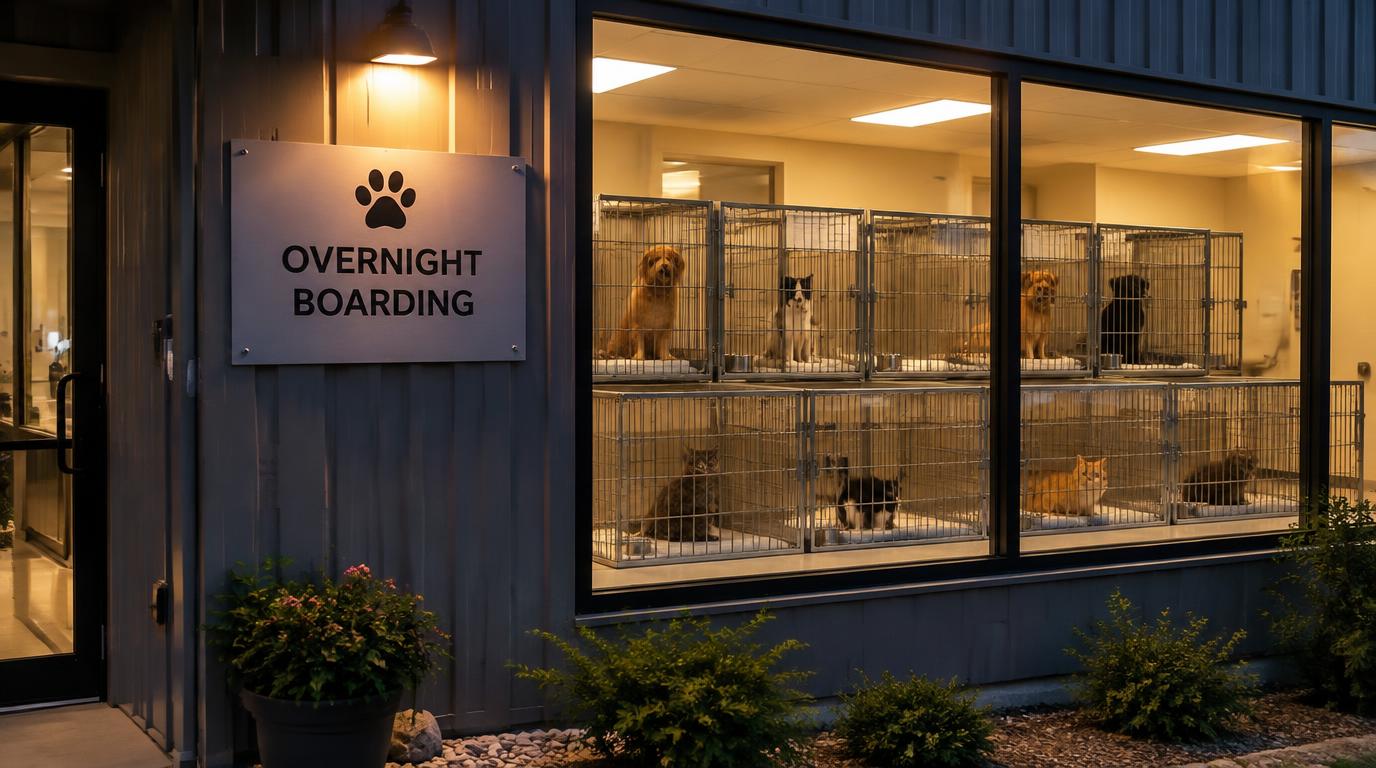
Right now, a boarding facility in Nevada can lock up for the night and leave dozens of dogs and cats unattended until morning. If a fire starts, the heat fails, or an animal chokes or goes into distress, no one is there to help. PAWS changes that.
What PAWS will do
PAWS sets a minimum standard of overnight care for every business in Nevada that takes custody of your dog or cat for the night — kennels, pet boarding businesses, pet daycares offering overnight care, and dog training or board-and-train operations.
A person physically present all night
At least one trained attendant must physically be on the premises and awake during every overnight period or any hours that the premises is closed. Any type of cameras, on-call persons that are off-site, or an unattended alarm do not count.
Hands-on checks every two hours
Every boarded dog and cat is physically checked at least every two hours — breathing, responsiveness, signs of injury or distress, water, and housing temperature.
Trained, equipped, and authorized
Attendants are trained to recognize distress, handle animals, perform first aid and CPR, and evacuate — and can call for emergency veterinary care immediately, without waiting for management approval.
Working smoke and temperature alarms
Facilities must have functioning smoke detection and temperature monitoring with alarms that reach the on-site attendant, tested and documented every month.
A written emergency plan
Every facility keeps a written plan for fire, power or cooling failure, dangerous temperatures, serious illness or injury, escape, and evacuation — with a reachable emergency vet identified.
Records and honest disclosure
Check logs, staff schedules, training records and incident reports are kept for two years. Before accepting your animal, the facility must tell you in writing how it staffs overnight and handles emergencies.

Thank you to the facilities already doing it right
These Nevada boarding facilities already keep trained staff on-site around the clock, so a person is always there for the animals in their care. They prove that PAWS is achievable today — and they have earned your trust and your business. Next time your pet needs a place to stay, please consider one of them. They should be your first and only choice; because your fur baby is family and ensuring they are in a loving and safe facility should be the #1 priority!
0 of 0 facilities
No facility matches “”
Try a city like Las Vegas or Henderson, a ZIP code, or a facility name.
Do you know of a facility that already provides the 24/7 on-site staff and is not listed? Please complete the short submission below. We will verify the details and add them to this list.
It has already happened in Nevada
These are real, publicly reported Nevada cases. When a facility sits closed and unstaffed, there is no one there when minutes matter.
Las Vegas — March 2008
Paradise Pet Hospital fire kills 16 animals overnight
A fire broke out at Paradise Pet Hospital around midnight on Easter weekend. Thirteen boarded and hospitalized pets — Caesar, Carmac, Dojah, Jack, Jaguar, Manga, Martini, Pebbles, Rascal, Scottie, Shatzie, Spirit, and Willow — plus three clinic cats were inside. The building burned completely and every animal died. No one was on the premises.
Read the account (dvm360) →Las Vegas — August 2025
Fire inside a closed pet facility at 2 a.m.
Las Vegas Fire & Rescue responded just before 2 a.m. to heavy smoke inside NV Pet Hospice near Rancho Drive and Cheyenne Avenue. Firefighters traced it to an oven and put it out — but the building was closed and unstaffed, and only a passerby's report stood between that fire and a much worse outcome.
News 3 Las Vegas report →Las Vegas — June 2023
Nico dies within an hour at a boarding facility
A healthy 2-year-old dog named Nico was dropped off at Doggie District Silverado. Within an hour, staff found him unresponsive in his room; he could not be saved. His owners suspect heat stroke. When no one is watching closely, a dog in distress can be missed until it is too late.
FOX5 Las Vegas report →Clark County — 2024
Kennel's license suspended after dead dogs found in freezers
Clark County suspended the business license of A V-I-P Kennel after Animal Control found dogs living in filth and recovered the bodies of two dogs — a French bulldog that died of heat stroke symptoms and a Chow — from freezers. Veterinarians said both died from neglect or abuse.
FOX5 Investigates report →Every one of these tragedies shares the same gap: animals in cages, and no one there to see what was happening. PAWS closes that gap.
What it means for your fur baby
When you travel, you trust a boarding facility with a member of your family. You expect them to be fed, safe, and comfortable. What you don't expect is that the building may sit empty all night with no one there to notice if your animal is in trouble.
Under PAWS, a trained person is in the building with your dog or cat all night. They walk past every cage at least every two hours. They can spot labored breathing, bloat, panic, or injury — and they are authorized to get your animal to an emergency vet immediately instead of waiting for a manager to answer a phone.
If the worst happens — a fire, a power failure in summer heat, an escape — there is a written plan and a person on-site to carry it out. And if your animal is seriously hurt, you are notified promptly, with the incident documented.
In short: no more nights where the only thing standing between your animal and an emergency is an empty building.
Who it covers
- • Kennels and pet boarding businesses
- • Pet daycares that keep animals overnight
- • Dog training and board-and-train businesses
- • Any business paid to keep your dog or cat overnight — no matter how many animals, their age, or how the charges are itemized
Who it doesn't cover
- • A friend, family member, or neighbor watching your pet
- • Nonprofit animal shelters and rescues
- • Veterinary facilities while treating or hospitalizing your animal
A veterinary facility that offers ordinary commercial boarding is covered for those boarding operations.
Real teeth, not just guidelines
- County and city enforcement. Each county and city designates an animal control or other agency to enforce the act, with authority to inspect and access records.
- Civil penalties. Up to $1,000 for a first violation, $2,500 for a second within 24 months, and $5,000 for each violation after that. Each overnight period without staffing is one violation.
- Licensing consequences. A licensing authority can impose corrective conditions, or suspend or revoke a license. An imminent threat to animals can trigger emergency action.
- No waivers. A boarding contract cannot make you sign away these protections.
PAWS sets a minimum standard — local governments can still require more. The act takes effect for implementation when passed, with mandatory facility compliance by January 1, 2028.
Where other states stand
Nevada Animal Advocates supports requiring a trained, awake attendant to remain physically on-site whenever commercial facilities board dogs or cats overnight. Research covering all 50 states has not identified an unconditional statewide requirement applying to every commercial pet boarding facility. Some states instead require disclosure of unattended hours, signed owner consent, fire protection systems, or direct supervision under particular group-housing conditions.
State rules continue to change, and our extensive research has not turned up any statewide requirements that mandate 24/7 on-site staff. Some county and/or local ordinances may require it, but no statewide mandates exist.
This does not include states that have exemptions for qualifying fire protection, CCTV or other alternative means in lieu of staffing.
Local precedent: Ferguson Township, Pennsylvania, expressly requires on-site staff during overnight boarding hours for covered pet care facilities. This is a municipal ordinance, not Pennsylvania statewide law — Township ordinance, Pet Care Services Facility subsection J.
State requirements located
| State | Authority and finding | Effect on overnight staffing |
|---|---|---|
| Texas | Health and Safety Code §824.001–824.004. Covered kennels cannot leave dogs or cats unattended without an employee unless they give written notice specifying unattended hours and obtain the owner's signed consent. If the facility lacks a functioning sprinkler system, that must also be disclosed. Exceptions include animal shelters and kennels boarding no more than three dogs or cats at any time. §824.004 provides a $500 civil penalty per animal per day for violations. | Conditional employee-presence requirement. Signed owner consent permits unattended boarding. |
| Illinois | 225 ILCS 605/18.2; 8 Ill. Admin. Code §25.145. Boarding kennels not staffed whenever dogs or cats are present must have qualifying fire protection in each animal housing building. The statutory alternatives include a fire alarm or sprinkler system. | Staffing is an alternative to qualifying fire protection; it is not an unconditional staffing mandate. |
| Colorado | 8 CCR 1202-15, housing/classification provisions in the retrieved PACFA rules. Dogs from different households commingled in common areas require constant, direct human supervision. The retrieved rule requires a supervisor at least 16 years old, immediate access and constant viewing; cameras or viewing through windows do not satisfy the provision. | A narrower group-supervision rule, not a blanket requirement for all boarded animals overnight. |
| Maryland | Commercial Law §11-905. Veterinarians and commercial boarding kennel operators lacking 24-hour supervision by a person physically on the premises must notify animal owners in writing. The section provides a fine not exceeding $50. | Disclosure; continuous staffing is not required by this section. |
| California | Health and Safety Code §122384(a)(2) requires written information identifying the days and times personnel are on-site. §122383(b) separately requires observation as necessary and at least once every 24 hours. | Disclosure and observation requirements, not continuous staffing. |
| Maine | 7 M.R.S. §3932(5). Boarding kennels must post, and provide on request, a notice of fees and services that indicates the hours when the owner or a person responsible to the premises. | Disclosure of attendance hours; no blanket continuous-staffing requirement established by this section. |
| New Jersey | Betsy's Law, PL 2015, c.110, codified at N.J.S.A.45:16-8.3. Certain for-profit veterinary facilities must disclose that they do not provide supervision after normal business hours. | Disclosure, not mandatory overnight staff. It concerns veterinary care facilities, not general commercial boarding. |
| Nevada | NAC 638.060(8). A supervising veterinarian must ensure that owners or their designees receive written notice whether the boarding portion of a veterinary facility is staffed 24 hours each day or leaves animals unattended at certain times. | A veterinary boarding disclosure requirement, not a general commercial boarding staffing mandate. |
Other relevant findings
- Iowa: The retrieved dog daycare rules require direct and immediate visual supervision of playgroups and primary enclosures when dogs are not directly supervised. Overnight operations must comply with applicable housing and commingling rules. This is not evidence of a blanket overnight staffing mandate.
- Massachusetts: General Laws c. 140 §174G, enacted through Ollie's Law, directs the Department of Agricultural Resources to establish commercial boarding/training kennel standards, including staffing ratios, supervision and emergency planning. Official guidance identified June 2026 as the deadline for promulgating regulations. Final current overnight staffing requirements were not verified.
- New Hampshire: SB446-FN (2026) proposed notice and consent requirements for unattended dogs. The official bill-status page retrieved showed it laid on the Senate table on March 12, 2026 — it was not enacted law.
- New York: S8510/A9123 and A10731 appeared in searches as proposals to regulate boarding facilities. Their appearance in search results is not evidence of enacted requirements. This review did not establish an enacted blanket statewide overnight staffing mandate.
Help us take PAWS to Carson City
PAWS is a discussion draft prepared for Legislative Counsel Bureau review. We are building support, sharing the language with lawmakers, and asking pet owners to add their voices. If you believe no animal should spend the night unattended, tell your legislators.